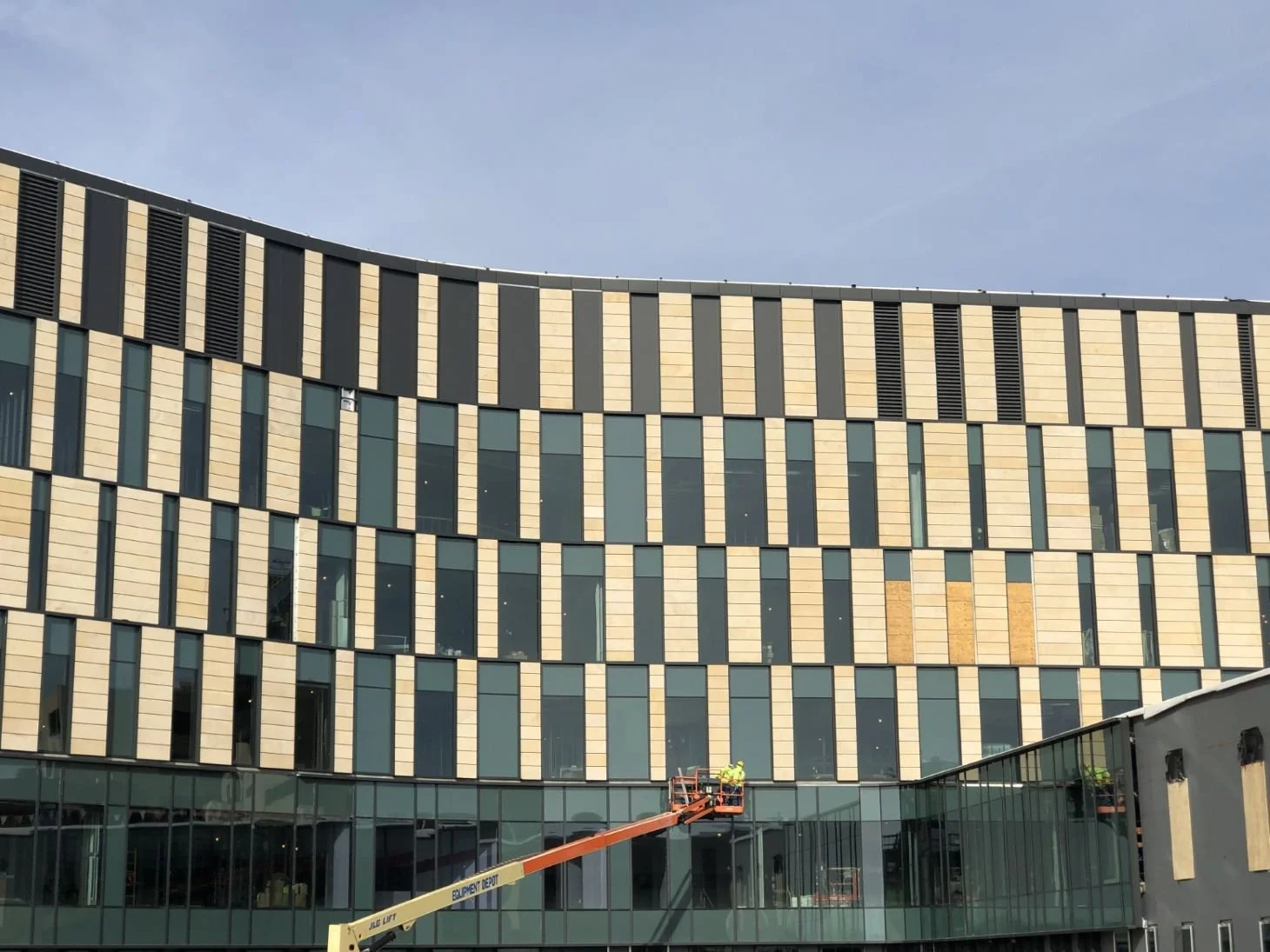
Photo provided by Altiers’
CEUs Cost Location
4 CE total Free Rhinegeist Brewery
2 LU/HSW provided
by AIA Cincinnati
Program Overview
Meet fellow architects, construction experts, and building professionals across the OH, KY, and IN markets. Establish high-value regional connections that directly lead to future project opportunities.
Earn up to four Continuing Education Units (CEUs). Master technical envelope installation, liability mitigation, and common failure prevention. Continuing Education sessions include Design Solutions in Clay You Never Thought Possible, Benefits of Thin Brick Wall Systems & Embedded Clay in Precast, and the following:
4 - 5 pm: Advancing Building Envelopes (1 LU/HSW)
At the Panel Discussion, industry professionals will share insights on design best practices and reliable building envelope systems that protect occupants from unsafe building environments and reduce long-term risk of failure of components.
Drawing on real-world experience, the presentation will identify common failures, demonstrate how to improve coordination among the team members, and guide smarter system choices.
Participants will explore practical strategies for moisture control, thermal performance, durability, and constructability while balancing aesthetics, cost, and safety.
Presented by the Knowledge Exchange - a collaboration of AIA Cincinnati and AIA Dayton
Learning Objectives
Identify common building envelope failure points—panelists will highlight field experiences—and explain where common failure occurs which impact moisture control, thermal continuity, durability, and ultimately occupant health and welfare.
Evaluate the constructability and installation risks of major envelopes systems, including cavity walls, rainscreens, and prefabricated panels to ensure safer, more reliable field performance. The panel will also discuss how different systems truly compare.
Analyze how design intent, performance requirements, and material choices influence envelope safety, indoor air quality, energy efficiency, aesthetics, and overall building resilience.
Panelists will review strategies for early coordination among architects, contractors, and specialty trades to reduce installation errors, prevent unsafe conditions, and align envelope design with field realities and long term performance goals. Also, part of the discussion will deal with how early collaboration reduces cost and risk.
Participants will learn what envelope systems are becoming more popular in the Midwest. Another topic to be covered is how labor shortages impact system selection. Also, the panel will go over what role sustainability plays in material selection today vs a few years ago.
Course number 2026G.b
Expiration Date: 4.13.29
2 - 3 pm: Designing Thermally Efficient Rainscreen Attachment Systems: Improving Building Envelope Performance Through Continuous Insulation Support (1 LU/HSW)
This presentation explores how thermally efficient rainscreen attachment systems directly influence building envelope performance, occupant comfort, and long-term durability. Using real-world wall assembly examples, the discussion focuses on how continuous girt and intermittent thermally isolated bracket systems impact thermal bridging, effective R-value, condensation potential, and moisture control.
Participants will review common detailing mistakes that compromise insulation continuity and learn practical strategies for designing framing systems that improve constructability, reduce risk, and support long-term building resilience. The program will also examine how early coordination between architects, structural teams, and specialty trades improves installation accuracy and overall wall performance.
Learning Objectives
Identify how rainscreen attachment systems influence thermal continuity, effective R-value, and occupant comfort within exterior wall assemblies.
Evaluate how continuous girt systems and thermally isolated bracket systems reduce thermal bridging, condensation risk, and long-term moisture-related failures.
Compare continuous and intermittent framing strategies based on constructability, structural support, insulation continuity, and long-term durability.
Apply coordination and detailing strategies that improve installation accuracy, reduce field errors, and support safer, more resilient building envelope performance.
Participants will also explore how thermally efficient support systems are becoming more widely adopted in commercial and institutional construction. Additional discussion topics include: labor-driven constructability decisions; installation tolerance management; energy code implications; evolving thermal performance requirements; and coordination between design teams and installers.
Presented by the Knowledge Exchange - a collaboration of AIA Cincinnati and AIA Dayton
Course number 2026G.c
Expiration Date: 4.27.29

AIA CES Provider Statement
AIA Cincinnati is a registered provider of AIA-approved continuing education under Provider Number 088. All registered AIA CES Providers must comply with the AIA Standards for Continuing Education Programs. Any questions or concerns about this provider or this learning program may be sent to AIA CES (cessupport@aia.org or (800) AIA 3837, Option 3).
This learning program is registered with AIA CES for continuing professional education. As such, it does not include content that may be deemed or construed to be an approval or endorsement by the AIA of any material of construction or any method or manner of handling, using, distributing, or dealing in any material or product.AIA continuing education credit has been reviewed and approved by AIA CES. Learners must complete the entire learning program to receive continuing education credit. AIA continuing education Learning Units earned upon completion of this course will be reported to AIA CES for AIA members. Certificates of Completion for both AIA members and non-AIA members are available upon request.